

Close Menu
Pest MagazinePest Magazine
  • News
    • National Pest Awards
    • BPCA
    • NPTA
    • Companies
    • Local Authority
    • Natural England
    • HSE
    • People
    • Products
    • Best Practice
    • Brexit
    • COVID-19
  • Species
    • Rodents
    • Insects
    • Birds
    • Mammals
  • Magazines
    • Oct / Nov 2026
    • Aug / Sep 2026
    • June / July 2026
    • April / May 2026
    • Feb / March 2026
    • Dec 2025 / January 2026
    • Oct / November 2025
  • Library
    • Inserts
    • Supplements
  • Professional Development
    • BASIS
    • Research
    • Stewardship
    • Training
  • Pest Test
  • Key Supporters
    • Bábolna Bio
    • Bell Laboratories
    • Pelsis
    • Envu
    • Lodi UK
    • PelGar International
    • Russell IPM
    • Syngenta
  • Jobs
    • Post a Job
    • Manage Jobs
X (Twitter) LinkedIn
  • Sign-up for weekly news emails
  • Subscribe to Pest Magazine
  • About Us
    • Technical Advisory Board
  • Advertise
  • Contact Us
Facebook X (Twitter) Instagram
Pest Test Log-In
Pest MagazinePest Magazine
  • News
    • National Pest Awards
    • BPCA
    • NPTA
    • Companies
    • Local Authority
    • Natural England
    • HSE
    • People
    • Products
    • Best Practice
    • Brexit
    • COVID-19
  • Species
    1. Rodents
    2. Insects
    3. Birds
    4. Mammals
    5. View All

    Mast year warning ahead of likely grey squirrel tree damage impacts

    10 November 2025

    Helping a luxury car showroom eradicate an infestation and steer clear of rodents

    25 March 2024

    Case Study – Freeing a pig farm of a severe rodent infestation in just 10 days

    11 May 2023

    Chinese takeaway issues apology after video of rats and raw chicken emerges

    14 July 2021

    The global insect pest control market to be worth $22.58bn by 2034

    21 August 2026

    UK gardens could be giving mosquitoes  the perfect breeding ground

    20 August 2026

    Heatwaves fuel Asian hornet invasion

    5 August 2026

    LNPS saves eco school bees

    8 June 2026

    UK & Ireland changes to bird licences for 2026

    12 January 2026

    Check your chimney for jackdaws before autumn arrives

    28 August 2025

    Worcester City Council increases budget to control gull numbers by £35,000

    26 October 2022

    BPCA urges householders and businesses to seek professional advice if birds are becoming a problem

    3 May 2022

    Conservation charity warns of need for joined-up approach and a fast-track to effective grey squirrel controls

    30 May 2025

    Squirrel charity welcomes new legislation on use of gene editing

    14 June 2022

    Ferrets to be removed as permitted target species for the DOC 250 spring trap

    13 April 2021

    Charity says planting of 30,000 hectares of trees must be matched by grey squirrel control

    10 February 2021

    The global insect pest control market to be worth $22.58bn by 2034

    21 August 2026

    UK gardens could be giving mosquitoes  the perfect breeding ground

    20 August 2026

    Heatwaves fuel Asian hornet invasion

    5 August 2026

    LNPS saves eco school bees

    8 June 2026
  • Magazines
    1. Oct / Nov 2026
    2. Aug / Sep 2026
    3. June / July 2026
    4. April / May 2026
    5. Feb / March 2026
    6. Dec 2025 / January 2026
    7. Oct / November 2025
    Featured

    Pest 107: Oct / Nov 2026

    By Simon King6 October 2026
    Recent

    Pest 107: Oct / Nov 2026

    6 October 2026

    Pest 106: Aug / Sep 2026

    5 August 2026

    Supplement: National Pest Awards 2026

    5 August 2026
  • Library
    • Inserts
    • Supplements
  • Professional Development
    • BASIS
    • Research
    • Stewardship
    • Training
  • Pest Test
  • Key Supporters
    • Bábolna Bio
    • Bell Laboratories
    • Pelsis
    • Envu
    • Lodi UK
    • PelGar International
    • Russell IPM
    • Syngenta
  • Jobs
    • Post a Job
    • Manage Jobs
Pest MagazinePest Magazine
News

Selontra delivers rapid control of heavy rat infestation on a working Scottish dairy

Simon KingBy Simon King19 October 2026No Comments4 Mins Read
LinkedIn Twitter Facebook Email

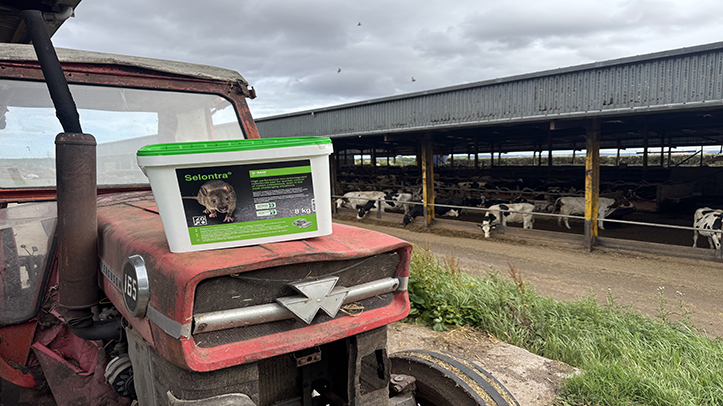
When Pest King took over pest control on a 300-cow dairy in Angus, Scotland, more than 150 Norway rats were estimated to be using the site. Within 7 to 14 days of using Selontra no further sightings were reported. Ben West, of Pest King, explains how this was achieved.

The farm is a working dairy farm of about 300 cows in Angus, Scotland, and the site features three cow sheds, a silage shed, a feed store and a slurry pit, with feed passages, gates and pipework linking those buildings together.

These interconnected areas had become home to over 150 Norway rats for over five years, as I discovered when I took on the contract.

The challenge
Following an initial inspection, I determined that the rats were not confined to one building. Fresh droppings ran throughout feed passages in the cow sheds, across the floor of the feed store, in the silage shed and along the edges of the slurry pit, with staff seeing rats several times a day.

A five-year anticoagulant rodenticide programme had been unable to resolve the problem, so a new approach was needed.

However, there were several challenges to overcome when devising a treatment. Unlike many domestic or commercial environments, removing the rats’ food source was not an option. The herd required continuous access to cattle feed, meaning the treatment had to achieve control despite an abundant food alternative being present. The site is also externally audited, which placed restrictions on where bait could be positioned.

Given the history of anticoagulant use and the continued level of rat activity, I was determined that the rats had developed a resistance to the anticoagulant bait, so following a detailed site assessment, he recommended discontinuing the existing programme and implemented a targeted treatment using Selontra.

The treatment
Selontra, a soft block containing 0.075% cholecalciferol, was placed on active rat runs in and around the cow sheds, the silage shed, the feed store, and the slurry pit yard. The external audit requirements restricted where product could be placed, so points were limited to approved, protected positions.

I identified 20 protected points, at which 4 to 5 blocks of Selontra were placed, locked into stations so they could not be reached by livestock, dogs or birds. I inspected these points after 24 hours, and then daily, replacing any eaten blocks. However, baiting was just one method used on the farm.

We always encourage an integrated approach to pest management. Alongside targeted baiting with Selontra, feed management practices, such as movement and storage of food, were reviewed and ongoing non-toxic monitoring was introduced. Combined, these provide a permanent and long-term solution to pest control.

The result
The results were almost instantaneous.

The bait was taken the very next day and on our early visits to the stations we saw that 60 to 70% of the bait had been removed, despite other food sources being available. Within 7 to 14 days bait consumption had significantly reduced, there were no new droppings, and no more sightings by staff members.

Continued control
Following the initial use of Selontra, I implemented an ongoing programme to ensure the rats did not return

Once all the bait had been consumed, we moved the farm off a continuous rodenticide programme. Food hygiene and housekeeping measures were reviewed and tightened where required, non-toxic monitoring devices were positioned at key areas of the site, and we visit every four weeks to monitor the situation. If we spot any new rodent activity a further targeted treatment of Selontra can be used.

Due to nature of the site, where cows, dogs and wildlife are all present, having a non-toxic pest-management programme is the safest and most effective approach. It has enabled us to transition the site from continuous rodenticide use to a monitoring-led approach – and when additional pest-control is needed Selontra can make a significant difference quickly and safely.

Why this case matters
This case demonstrates the importance of adapting rodent-control strategies where established infestations persist despite prolonged baiting programmes.

On this working dairy, a targeted Selontra treatment achieved rapid bait uptake and a significant reduction in observed rat activity, allowing the site to transition from continuous rodenticide use to a monitoring-led approach.

Share. LinkedIn Facebook Twitter Email
Previous ArticleTyro Group UK to exhibit at PestTech 2026
Simon King

With more than 25 years' experience in business-to-business publishing, Simon is editor of LBM titles Pest and OvertheCounter. Big fan of Manchester United.

Read Similar Stories

Tyro Group UK to exhibit at PestTech 2026

BPCA chief executive Rosina Robson defends working dogs at Stormont

BPCA yellow-legged (Asian) hornet debate now available to watch

Latest Stories

Selontra delivers rapid control of heavy rat infestation on a working Scottish dairy

19 October 2026

Tyro Group UK to exhibit at PestTech 2026

16 October 2026

BPCA chief executive Rosina Robson defends working dogs at Stormont

15 October 2026
Key Supporters
  • Pelsis
  • Syngenta
  • Russell IPM
  • PelGar International
  • Lodi UK
  • Envu
  • Bell Laboratories
  • Bábolna Bio
© 2026 Lewis Business Media. All Rights Reserved.
Lewis Business Media (Arts) Ltd, The Courtyard, River Way, Uckfield, East Sussex, TN22 1SL

Privacy Policy | Cookie Policy | Terms & Conditions

  • National Pest Awards
  • OvertheCounter
  • Pet Business World

Type above and press Enter to search. Press Esc to cancel.

Pest Magazine
Managing Your Privacy

To provide the best digital experience, we use cookies to store and/or access device information. Consenting to our use of cookies allows us to process data such as reading behaviour. Not consenting or withdrawing consent, may adversely affect certain features and functions.

Functional Always active
The technical storage or access is strictly necessary for the legitimate purpose of enabling the use of a specific service explicitly requested by the subscriber or user, or for the sole purpose of carrying out the transmission of a communication over an electronic communications network.
Preferences
The technical storage or access is necessary for the legitimate purpose of storing preferences that are not requested by the subscriber or user.
Statistics
The technical storage or access that is used exclusively for statistical purposes. The technical storage or access that is used exclusively for anonymous statistical purposes. Without a subpoena, voluntary compliance on the part of your Internet Service Provider, or additional records from a third party, information stored or retrieved for this purpose alone cannot usually be used to identify you.
Marketing
The technical storage or access is required to create user profiles to send advertising, or to track the user on a website or across several websites for similar marketing purposes.
  • Manage options
  • Manage services
  • Manage {vendor_count} vendors
  • Read more about these purposes
Cookie Preferences
  • {title}
  • {title}
  • {title}