


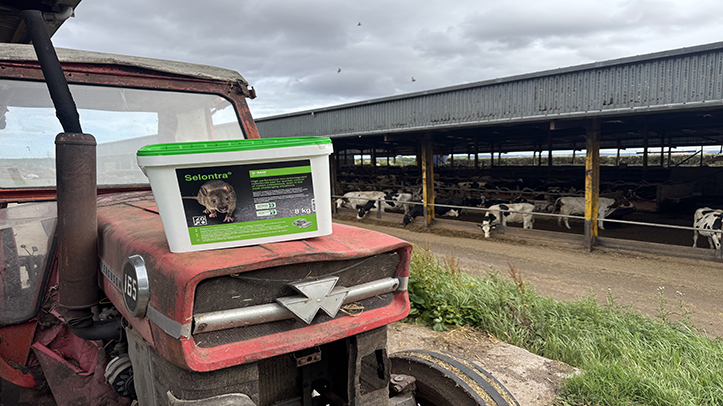
When Pest King took over pest control on a 300-cow dairy in Angus, Scotland, more than 150 Norway rats were estimated to be using the site. Within 7 to 14 days of using Selontra no further sightings were reported. Ben West, of Pest King, explains how this was achieved.
The farm is a working dairy farm of about 300 cows in Angus, Scotland, and the site features three cow sheds, a silage shed, a feed store and a slurry pit, with feed passages, gates and pipework linking those buildings together.
These interconnected areas had become home to over 150 Norway rats for over five years, as I discovered when I took on the contract.
The challenge
Following an initial inspection, I determined that the rats were not confined to one building. Fresh droppings ran throughout feed passages in the cow sheds, across the floor of the feed store, in the silage shed and along the edges of the slurry pit, with staff seeing rats several times a day.
A five-year anticoagulant rodenticide programme had been unable to resolve the problem, so a new approach was needed.
However, there were several challenges to overcome when devising a treatment. Unlike many domestic or commercial environments, removing the rats’ food source was not an option. The herd required continuous access to cattle feed, meaning the treatment had to achieve control despite an abundant food alternative being present. The site is also externally audited, which placed restrictions on where bait could be positioned.
Given the history of anticoagulant use and the continued level of rat activity, I was determined that the rats had developed a resistance to the anticoagulant bait, so following a detailed site assessment, he recommended discontinuing the existing programme and implemented a targeted treatment using Selontra.
The treatment
Selontra, a soft block containing 0.075% cholecalciferol, was placed on active rat runs in and around the cow sheds, the silage shed, the feed store, and the slurry pit yard. The external audit requirements restricted where product could be placed, so points were limited to approved, protected positions.
I identified 20 protected points, at which 4 to 5 blocks of Selontra were placed, locked into stations so they could not be reached by livestock, dogs or birds. I inspected these points after 24 hours, and then daily, replacing any eaten blocks. However, baiting was just one method used on the farm.
We always encourage an integrated approach to pest management. Alongside targeted baiting with Selontra, feed management practices, such as movement and storage of food, were reviewed and ongoing non-toxic monitoring was introduced. Combined, these provide a permanent and long-term solution to pest control.
The result
The results were almost instantaneous.
The bait was taken the very next day and on our early visits to the stations we saw that 60 to 70% of the bait had been removed, despite other food sources being available. Within 7 to 14 days bait consumption had significantly reduced, there were no new droppings, and no more sightings by staff members.
Continued control
Following the initial use of Selontra, I implemented an ongoing programme to ensure the rats did not return
Once all the bait had been consumed, we moved the farm off a continuous rodenticide programme. Food hygiene and housekeeping measures were reviewed and tightened where required, non-toxic monitoring devices were positioned at key areas of the site, and we visit every four weeks to monitor the situation. If we spot any new rodent activity a further targeted treatment of Selontra can be used.
Due to nature of the site, where cows, dogs and wildlife are all present, having a non-toxic pest-management programme is the safest and most effective approach. It has enabled us to transition the site from continuous rodenticide use to a monitoring-led approach – and when additional pest-control is needed Selontra can make a significant difference quickly and safely.
Why this case matters
This case demonstrates the importance of adapting rodent-control strategies where established infestations persist despite prolonged baiting programmes.
On this working dairy, a targeted Selontra treatment achieved rapid bait uptake and a significant reduction in observed rat activity, allowing the site to transition from continuous rodenticide use to a monitoring-led approach.