

Close Menu
Pest MagazinePest Magazine
  • News
    • National Pest Awards
    • BPCA
    • NPTA
    • Companies
    • Local Authority
    • Natural England
    • HSE
    • People
    • Products
    • Best Practice
    • Brexit
    • COVID-19
  • Species
    • Rodents
    • Insects
    • Birds
    • Mammals
  • Magazines
    • April / May 2026
    • Feb / March 2026
    • Dec 2025 / January 2026
    • Oct / November 2025
    • Aug / Sept 2025
    • Supplement: National Pest Awards 2025
    • June / July 2025
    • April / May 2025
  • Library
    • Inserts
    • Supplements
  • Professional Development
    • BASIS
    • Research
    • Stewardship
    • Training
  • Pest Test
  • Key Supporters
    • Bábolna Bio
    • Bell Laboratories
    • Pelsis
    • Envu
    • Lodi UK
    • PelGar International
    • Russell IPM
    • Syngenta
  • Jobs
    • Post a Job
    • Manage Jobs
X (Twitter) LinkedIn
  • Sign-up for weekly news emails
  • Subscribe to Pest Magazine
  • About Us
    • Technical Advisory Board
  • Advertise
  • Contact Us
Facebook X (Twitter) Instagram
Pest Test Log-In
Pest MagazinePest Magazine
  • News
    • National Pest Awards
    • BPCA
    • NPTA
    • Companies
    • Local Authority
    • Natural England
    • HSE
    • People
    • Products
    • Best Practice
    • Brexit
    • COVID-19
  • Species
    1. Rodents
    2. Insects
    3. Birds
    4. Mammals
    5. View All

    Mast year warning ahead of likely grey squirrel tree damage impacts

    10 November 2025

    Helping a luxury car showroom eradicate an infestation and steer clear of rodents

    25 March 2024

    Case Study – Freeing a pig farm of a severe rodent infestation in just 10 days

    11 May 2023

    Chinese takeaway issues apology after video of rats and raw chicken emerges

    14 July 2021

    Hidden cockroach infestations could be spreading unnoticed in UK homes and businesses

    29 May 2026

    Keep windows shut this winter to reduce the bed bug risk

    24 December 2025

    Bed bug warning for people using an electric blanket to keep warm

    16 December 2025

    Insecticide resistance: what pest controllers need to know and how to overcome it

    20 October 2025

    UK & Ireland changes to bird licences for 2026

    12 January 2026

    Check your chimney for jackdaws before autumn arrives

    28 August 2025

    Worcester City Council increases budget to control gull numbers by £35,000

    26 October 2022

    BPCA urges householders and businesses to seek professional advice if birds are becoming a problem

    3 May 2022

    Conservation charity warns of need for joined-up approach and a fast-track to effective grey squirrel controls

    30 May 2025

    Squirrel charity welcomes new legislation on use of gene editing

    14 June 2022

    Ferrets to be removed as permitted target species for the DOC 250 spring trap

    13 April 2021

    Charity says planting of 30,000 hectares of trees must be matched by grey squirrel control

    10 February 2021

    Hidden cockroach infestations could be spreading unnoticed in UK homes and businesses

    29 May 2026

    UK & Ireland changes to bird licences for 2026

    12 January 2026

    Keep windows shut this winter to reduce the bed bug risk

    24 December 2025

    Bed bug warning for people using an electric blanket to keep warm

    16 December 2025
  • Magazines
    1. April / May 2026
    2. Feb / March 2026
    3. Dec 2025 / January 2026
    4. Oct / November 2025
    5. Aug / Sept 2025
    6. Supplement: National Pest Awards 2025
    7. June / July 2025
    8. April / May 2025
    Featured

    Pest 104: April / May 2026

    By Simon King7 April 2026
    Recent

    Pest 104: April / May 2026

    7 April 2026

    Pest 103: February / March 2026

    10 February 2026

    Pest 102: December 2025 / January 2026

    1 December 2025
  • Library
    • Inserts
    • Supplements
  • Professional Development
    • BASIS
    • Research
    • Stewardship
    • Training
  • Pest Test
  • Key Supporters
    • Bábolna Bio
    • Bell Laboratories
    • Pelsis
    • Envu
    • Lodi UK
    • PelGar International
    • Russell IPM
    • Syngenta
  • Jobs
    • Post a Job
    • Manage Jobs
Pest MagazinePest Magazine
Rodents

They’ve done it! South Georgia declared rodent free

Frances McKimBy Frances McKim30 May 2018No Comments4 Mins Read
LinkedIn Twitter Facebook Email

At a press conference held on 8 May in central London, the Antarctic island of South Georgia was officially declared to be rodent free. This is a position it was in originally, two centuries ago, before the invasion of escapee rodents from the sealers’ and whalers’ ships that set up business there.
Great news certainly – but maybe more encouragingly is that this good news story, as opposed to all the bad news we continually get fed, has caught the attention of not only UK and overseas national and regional press but also national radio and TV. This included an interview with Alison Neil, chief executive of the South Georgia Heritage Trust  perched on the red settee of BBC Breakfast.

From a pest control perspective it puts into a very positive light the role of rodenticides. Without rodenticides, all supplied by Bell Laboratories, there would still be rats. And these rodenticides were used on an island with an extremely high wild bird population. At the press conference, when challenged on rodenticide dangers to the wildlife, or more appropriately the risks of secondary poisoning, the reply was they were aware there might be some co-lateral damage but viewed the benefits gained greatly outweighed any risks posed. The rodenticide bait used exclusively was specially formulated and packed brodifacoum bait manufactured by US-based Bell Laboratories – a large percentage of which was donated.

Opening the press conference, Philippa Foster Back CBE, chairman of the Scottish-based charity, the South Georgia Heritage Trust (SGHT) delivered the news we were all there to hear – that South Georgia is now rodent free.

Philippa FosterPhilippa Foster Back CBE
Chairman of the SGHT

Dickie HallDickie Hall
Habitat Restoration project director

Lord GardinerLord Gardiner, Parliamentary
Under-Secretary, DEFRA

How it all started
Dickie Hall, the Habitat Restoration project director explained how the SGHT started planning this ambitious project in 2008, with the aim of reversing two centuries of human-induced damage to the island’s wildlife, so that millions of birds could reclaim their ancestral home. The Trust launched the pilot phase of baiting in 2011, followed by a second phase in 2013/14 and a third phase in 2015/16 – as reported in Pest magazine.

Following international best practice, more than two years after the last baiting work, a comprehensive survey was essential before the island could officially be declared free of rodents. A further six months was spent on South Georgia by ‘Team Rat’ searching for any signs of surviving rats using a combination of detection methods. Over 4,600 inert devices, including chewsticks and tracking tunnels, were deployed and checked. The very best rodent detection experts were also brought in especially: three highly trained ‘sniffer’ dogs and their two skilled female handlers (see Pest magazine report).

The Trust, along with its US-based counterpart the Friends of South Georgia Island (FOSGI), raised £10million to finance the entire Habitat Restoration Project, securing financial and in-kind support from numerous individuals, foundations, businesses, and government, including £885K from the UK Government through DEFRA and the Darwin Initiative.

Hope regarding other alien invasive species
Lord Gardiner, Parliamentary Under-Secretary, DEFRA said: “The UK is proud to be custodian of the precious and unique biodiversity of 14 overseas territories, most of which are island environments, like South Georgia, that are highly vulnerable to environmental change. The last ten years has seen a step-change in how the UK responds to invasive non-native species and the rodent eradication work completed by the South Georgia Heritage Trust is undoubtedly among the most remarkable of recent island conservation efforts. This successful project gives confidence and offers hope for invasive alien species management around the globe.”

A national and international good news story
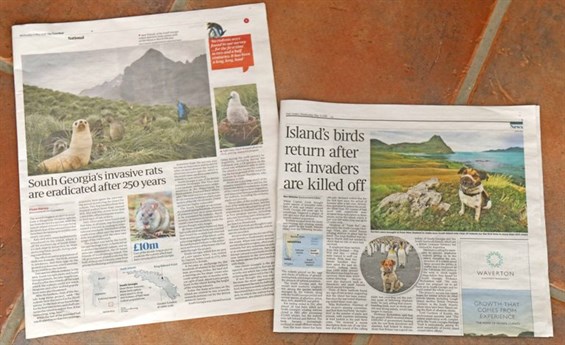
CoverageJust two clippings from the UK national press – The Guardian (left) and The Times (right)

The story also appeared in a very wide selection of international titles, such as New Scientist, National Geographic, the Japan Times, the Smithsonian and conservation titles such as Island Conservation and BBC Wildlife Magazine.

Share. LinkedIn Facebook Twitter Email
Previous ArticleRecord numbers attend Benelux Pest 2018
Next Article The law of unintended consequences!
Frances McKim

Read Similar Stories

Mast year warning ahead of likely grey squirrel tree damage impacts

Helping a luxury car showroom eradicate an infestation and steer clear of rodents

Case Study – Freeing a pig farm of a severe rodent infestation in just 10 days

Latest Stories

‘Pest anxiety’ reported as Brits fear infestations at home

5 June 2026

Rodent glue traps to be banned in Scotland from July 1, 2026

4 June 2026

Farms hold key to break rodenticide resistance spread

3 June 2026
Key Supporters
  • Pelsis
  • Syngenta
  • Russell IPM
  • PelGar International
  • Lodi UK
  • Envu
  • Bell Laboratories
  • Bábolna Bio
© 2026 Lewis Business Media. All Rights Reserved.
Lewis Business Media, Suite A, Arun House, Office Village, River Way, Uckfield, TN22 1SL

Privacy Policy | Cookie Policy | Terms & Conditions

  • National Pest Awards
  • OvertheCounter
  • Pet Business World

Type above and press Enter to search. Press Esc to cancel.

Pest Magazine
Managing Your Privacy

To provide the best digital experience, we use cookies to store and/or access device information. Consenting to our use of cookies allows us to process data such as reading behaviour. Not consenting or withdrawing consent, may adversely affect certain features and functions.

Functional Always active
The technical storage or access is strictly necessary for the legitimate purpose of enabling the use of a specific service explicitly requested by the subscriber or user, or for the sole purpose of carrying out the transmission of a communication over an electronic communications network.
Preferences
The technical storage or access is necessary for the legitimate purpose of storing preferences that are not requested by the subscriber or user.
Statistics
The technical storage or access that is used exclusively for statistical purposes. The technical storage or access that is used exclusively for anonymous statistical purposes. Without a subpoena, voluntary compliance on the part of your Internet Service Provider, or additional records from a third party, information stored or retrieved for this purpose alone cannot usually be used to identify you.
Marketing
The technical storage or access is required to create user profiles to send advertising, or to track the user on a website or across several websites for similar marketing purposes.
  • Manage options
  • Manage services
  • Manage {vendor_count} vendors
  • Read more about these purposes
Cookie Preferences
  • {title}
  • {title}
  • {title}